Heading off on a road trip? Before you load up the boot and queue the playlist, take five minutes to check your tyre pressures. You’ll find the number you need on your car’s tyre placard, usually inside the driver’s door. Car packed to the roof or towing something? Switch to the higher loaded figure. It’s one of the easiest ways to improve handling, braking and tyre life on a long drive. It’s also a great first step to getting your car road trip ready.
How Do You Check Your Tyre Pressure?
All you need is a tyre pressure gauge, an air pump and about five minutes. That’s less time than it takes to grab a coffee at the servo.
- Check your tyres cold, before you drive or after a short trip to your local servo.
- Find the right pressure on your tyre placard or in your owner’s manual. Front and rear tyres can have different requirements.
- Unscrew the valve cap.
- Press the gauge firmly onto the valve and read the pressure.
- Add air until you reach the right figure, or press the pin in the middle of the valve to let some out.
- Check again, then screw the valve cap back on.
- Repeat for every tyre, and don’t forget the spare.
What Kind of Tyre Pressure Gauge Should You Use?
Any gauge will do the job. A basic stick or dial gauge is cheap and reliable, and a digital one is easier to read at a glance. Keep one in the glovebox and you’ll never have an excuse to skip a check.
Can You Check Tyre Pressure at a Petrol Station?
Yes. Most petrol stations have an air machine. Set your target pressure, attach the hose to the valve and the machine will stop when it gets there. If you’ve got your own gauge, double-check the reading. Servo air machines get used by hundreds of drivers a week, so their gauges aren’t always spot on.
What Should My Tyre Pressure Be?
The right pressure for your car will be on the tyre placard and in your owner’s manual. There isn’t one number that suits every car. For context, most everyday passenger cars sit around 30 to 36 PSI (about 210 to 250 kPa). Your own placard always has the final say though.
Where Is My Tyre Placard?
On most cars, it’s a sticker on the driver’s door frame. No luck? Try inside the fuel flap or the glovebox. Still can’t find it? It’s in your owner’s manual too. Cars in Australia have had to carry a tyre placard since 1973 (Transport Tasmania), so it’s there somewhere.
How Do I Read My Tyre Placard?
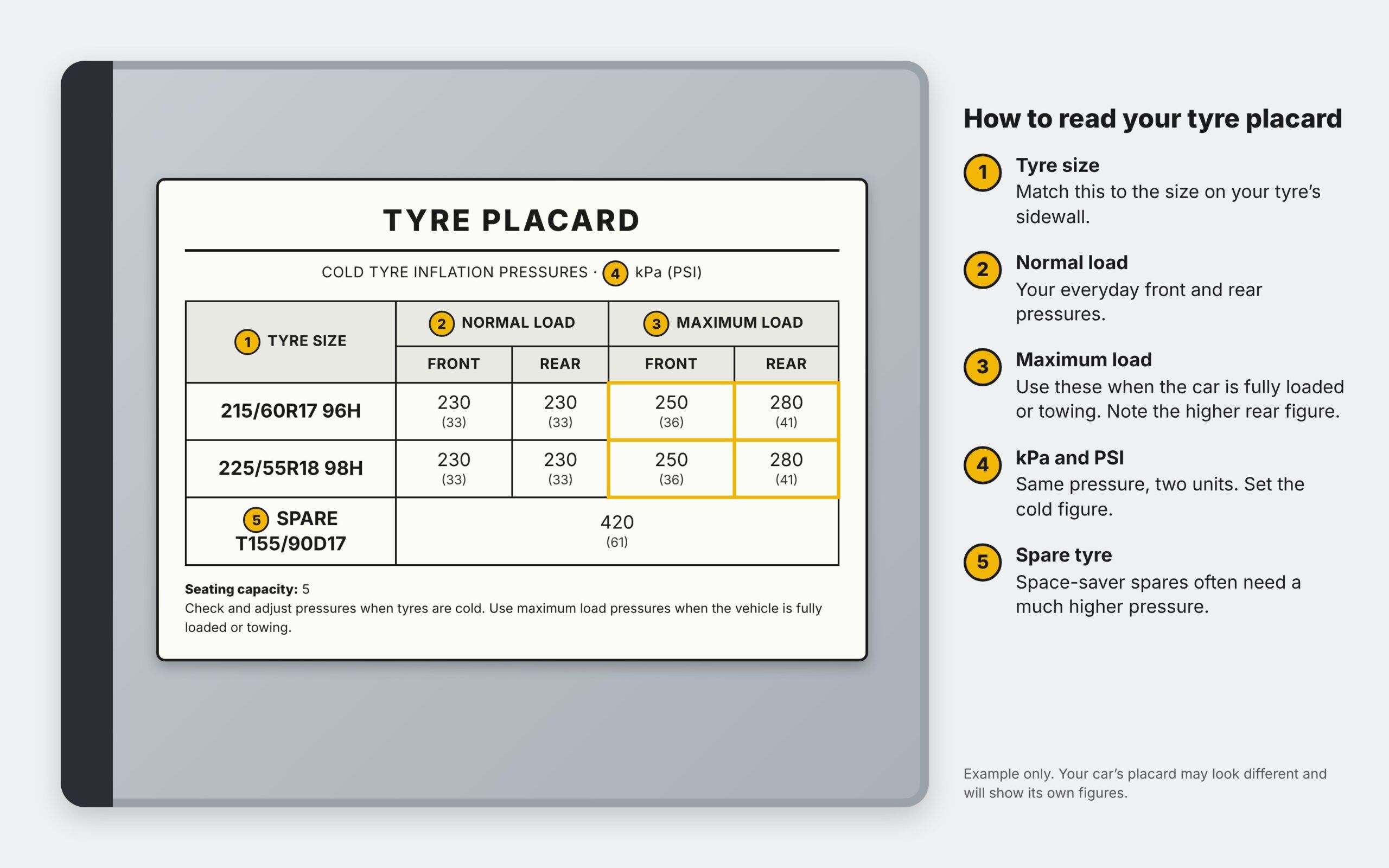
Placards vary between makes, but most show:
- The tyre sizes your car is built to run. Match these to the size on your tyre’s sidewall (here’s how to read your tyre size)
- Separate pressures for the front and rear tyres
- On many cars, a second, higher set of pressures for when the car is loaded
- Pressures in kPa, and often in PSI too
If your car is packed for a trip or towing, the second set of figures is the one you’ll use.
Why Isn’t the Number on My Tyre the Right Pressure?
The number moulded into your tyre’s sidewall is the maximum pressure that tyre can safely hold, not the pressure your car should run on. Pump your tyres up to it and you’ll get a harsher ride and less grip. There’s also no room left for the pressure to rise as the tyres warm up. Think of the sidewall number as a limit, not a target, and stick to your placard.
How Do You Adjust Tyre Pressure for a Loaded Car or Towing?
When your car is fully loaded or towing, you should raise your tyre pressures to the loaded figure on your placard or in your owner’s manual. This advice is also provided by Queensland Transport and Main Roads in its Safe Towing guide, and VicRoads in its pre-trip checklist.
You might be asking: do I really need to bother? Short answer: yes. Extra weight squashes your tyres more, which builds heat and makes the car feel softer and less stable. The right pressure keeps each tyre in shape, so it carries the load the way it was designed to.
The right tyre pressure number depends on your car, your tyres and what you’re carrying or towing.
Should You Increase Tyre Pressure When Your Car Is Fully Loaded?
Yes, if your placard or manual lists a loaded figure. Five people, a packed boot and a roof pod? That’s a loaded car, so it’s time to pump those tyres up to the loaded figure.
What Tyre Pressure Should You Use When Towing?
Use the loaded or towing figure from your placard or manual, set with the tyres cold before you leave. While you’ve got the manual out, check your towing capacity too, and stay within it.
Why Does Rear Tyre Pressure Matter Most When Towing?
The weight of your caravan or trailer pushes down on the tow ball, so your rear tyres end up doing most of the heavy lifting. That’s why many placards list a higher rear pressure for a loaded car.
What If My Placard Doesn’t Show a Loaded Figure?
Check your owner’s manual. If it’s still not clear, ask your vehicle manufacturer or a tyre specialist. The right figure really does vary from car to car.
Towing a caravan or trailer? Its tyres have their own pressures, set by the caravan or trailer maker, so check its compliance plate or manual.
Should You Check Tyre Pressure Hot or Cold?
Always cold. Driving heats your tyres and pushes the pressure up, so a reading taken straight after a long drive will look higher than it really is. Don’t let air out of hot tyres to match your placard either. Once they cool down, you’ll be driving on soft tyres.
PSI or kPa: Which Should You Use?
Either. They’re just two ways of saying the same thing, and most Australian placards and air machines show both. One PSI is about 6.9 kPa, so 32 PSI is roughly 220 kPa.
What Happens If Your Tyre Pressure Is Too Low or Too High?
Get your pressures wrong and your car will let you know. You’ll feel it in how it drives, and you’ll see it in how fast your tyres wear.
Too low:
- Tyres flex and heat up, especially on a long, loaded highway run
- Longer braking distances and vaguer steering
- Faster wear on the outside edges
- Higher fuel use
Too high:
- Less grip, especially in the wet
- A harsher ride
- Faster wear down the centre of the tread
Uneven wear can also point to an alignment or balancing problem. Here’s the difference between wheel alignment and wheel balancing.
What Does the Tyre Pressure Warning Light Mean?
Many newer cars will tell you when a tyre drops below a set pressure. When that light comes on, check all four tyres with a gauge and look for a nail or other damage. A tyre that keeps losing air is trying to tell you something. It could be a puncture or slow leak, and a quick tyre repair at your local Midas could save the tyre.
Your Road Trip Tyre Checklist
Pressures sorted? Run through the rest of your tyre checks before you hit the road.
Before you go:
- Tread depth: at least 1.5mm, the legal minimum (Transport Victoria)
- Damage: look for cuts, bulges and nails, and get anything suspicious looked at before you leave (tyre repair and replacement)
- Tyre age: VicRoads advises having tyres over six years old inspected and replacing any over ten years old, spare included
- Spare: in good shape, with the jack and wheel brace in the car (here’s how to change a flat tyre)
On the road:
- Towing? Check your tyres soon after setting off, then every two to three hours on long trips (Queensland Transport and Main Roads)
When you get home:
- Set your pressures back to the normal figure once you’ve unloaded
Get Road Trip Ready at Midas
With over 50 years’ experience keeping Australians on the road, we know what a long drive asks of your car. Want a second pair of eyes before you head off? A Road Trip Ready check at Midas includes checking your tread depth and setting your tyre pressures to manufacturer specs. We’ll also look over your brakes, suspension and battery, and check under the bonnet. Book online or find your nearest store.
Tyre Pressure FAQs
At least once a month, and before every long trip.
It can be, but only if that’s what your placard says (35 PSI is about 240 kPa). Your mate’s car might run 35 PSI and yours might not, so always go by your own.
Pressure drops when it’s cold and rises in the heat, so check a little more often when the seasons change.
On the road, a 4WD uses the pressures on its placard, including the loaded or towing figure when you’re packed up. Letting air out for sand or off-road driving is a different job. Pump your tyres back up before you hit the bitumen again.